Cheapest Way to Buy Cardboard Boxes in Bulk for a Small UK Business
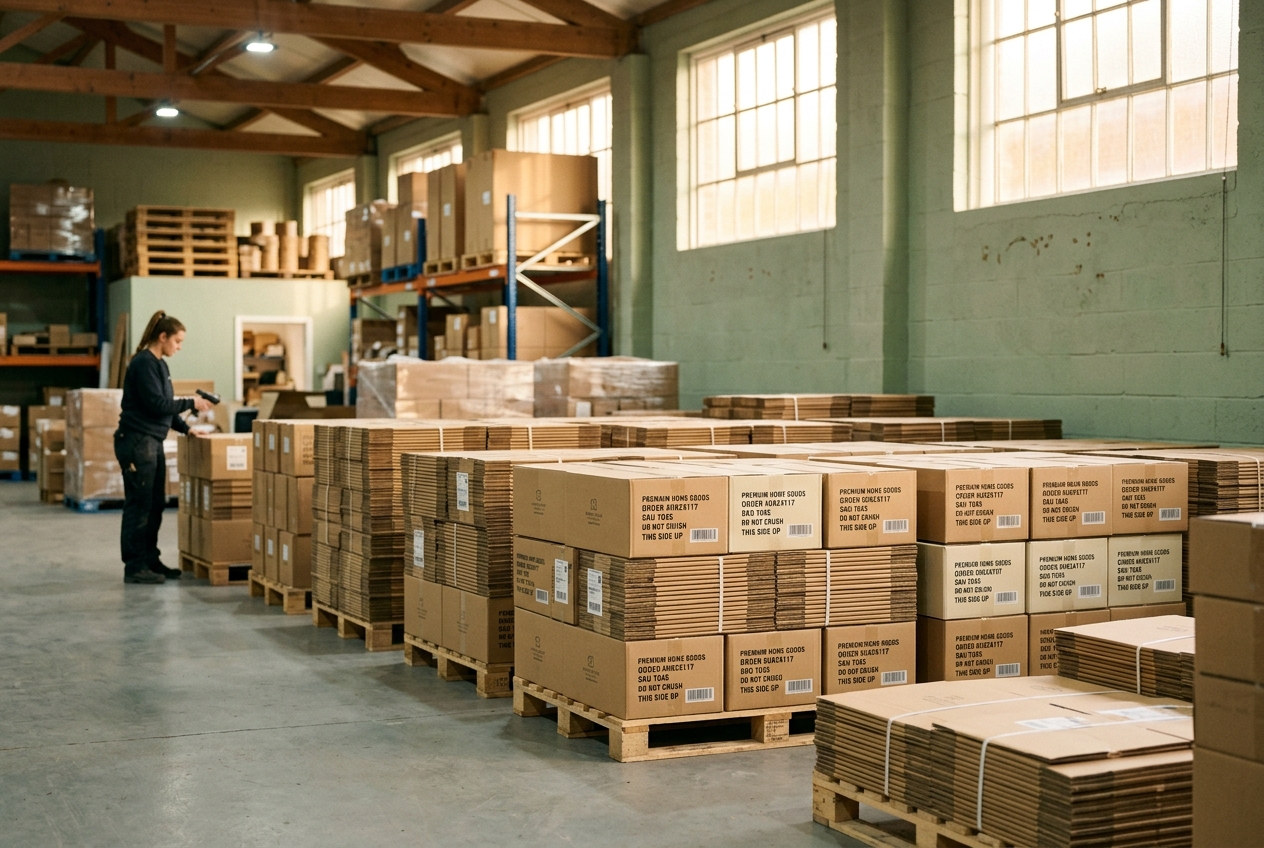
Cardboard boxes are one of those costs that can add up fast if you are not paying attention. Buy too few and you pay a premium per box. Buy too many and you tie up cash in stock that sits in a corner. This guide covers every practical route to getting the best price.
What does "bulk" actually mean for a small business?
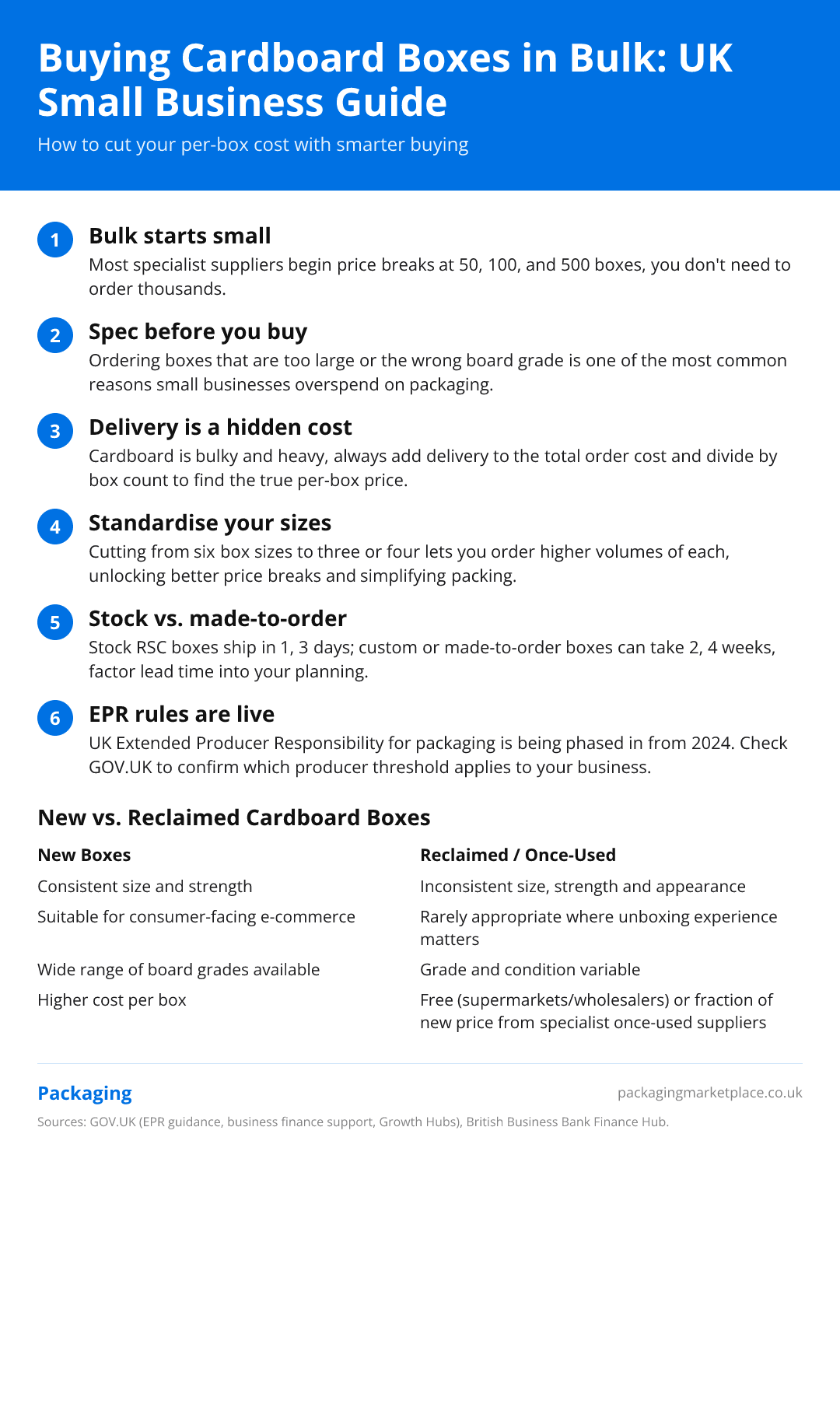
For most small UK businesses, bulk simply means buying more than a handful at a time, typically starting from 25 to 50 boxes per size. Most specialist packaging suppliers drop their per-unit price at quantities of 50, 100, and 500. You do not need to order thousands to see a real saving.
Which types of supplier offer the lowest prices on bulk cardboard boxes?
The cheapest options generally fall into four categories, each with trade-offs.
- Specialist packaging wholesalers. Companies that sell packaging as their primary product (rather than office supplies on the side) almost always offer the lowest base prices at volume. They stock a wide range of single-wall, double-wall and heavy-duty corrugated boxes, and their price breaks are designed around repeat business orders.
- Manufacturer-direct suppliers. Some UK corrugated board manufacturers sell direct to trade customers. Minimum order quantities are higher, but the cost per box can be significantly lower than going through a distributor. This route works best once you know exactly which size and board grade you need consistently.
- B2B trade platforms. Several online marketplaces list bulk packaging from multiple suppliers and display VAT-exclusive prices for registered business accounts. They are useful for quick comparisons, but delivery costs vary widely so always calculate the total landed cost before concluding which deal is best.
- Local trade suppliers and cash-and-carry. If you can collect rather than pay for delivery, a local packaging trade supplier or even a large cash-and-carry can undercut online prices on smaller quantities. Delivery on heavy cardboard orders is a real cost, so removing it matters.
How much cheaper is buying in bulk compared to buying small quantities?
The saving varies by supplier and box size. As a general pattern, moving from a small pack to a larger quantity of the same box reduces the per-unit price noticeably, and the saving grows further at higher volumes. Always compare on a per-box basis, then add the delivery cost back in before concluding which order size is actually cheapest. Ask each supplier for their full price-break schedule so you can see exactly where the drops occur.
Nail down your box specification before getting quotes
The most important step before approaching any supplier is to define exactly what you need. Getting the specification wrong is one of the most common reasons small businesses overspend on packaging. Ordering boxes that are too large wastes void-fill material and increases shipping costs. Ordering boxes with too light a board grade leads to damage claims.
- Internal dimensions. Measure your product at its widest point, then add a small allowance for padding. Boxes are quoted as length x width x depth (internal).
- Board grade. Single-wall (B or C flute) suits most retail and e-commerce parcels up to around 20 kg. Double-wall suits heavier or fragile goods. Using double-wall when single-wall is sufficient is a common source of unnecessary cost.
- Box style. Regular slotted cartons (RSC) are the most widely stocked and therefore the cheapest. Die-cut or unusual shapes cost more and often carry a tooling charge.
- Quantity per pallet. Ask the supplier how many boxes fit on a full pallet. Ordering full pallets removes the small-order surcharge that many suppliers apply.
Standardising on fewer box sizes consistently saves money
If you currently use six different box sizes, consolidating to three or four means you can order higher volumes of each. Higher volumes per size unlocks better price breaks and reduces the risk of running out of one size while overstocked on another. It also simplifies packing, which saves labour time.
Recycled and reclaimed cardboard: a genuine option for some businesses
Used boxes from supermarkets, wholesalers or removal companies are essentially free, but they are inconsistent in size, strength and appearance. They are fine for internal storage or sending goods to trade customers who do not mind. For consumer-facing e-commerce, where unboxing experience and brand perception matter, they are rarely appropriate. Some specialist once-used box suppliers sell graded second-hand boxes at a fraction of new prices, which can be a useful middle ground for the right business.
How does delivery cost affect the total price?
Cardboard boxes are bulky and, in larger quantities, heavy. Delivery charges can add a meaningful amount to your order cost if you are not careful. Strategies to reduce this include:
- Ordering full pallets rather than part-pallets, as many suppliers offer free pallet delivery above a spend threshold.
- Using a supplier with a warehouse near you, or one with regional distribution points.
- Collecting from a local trade counter if the supplier has one, which removes delivery costs entirely.
- Consolidating orders so you buy less frequently in larger quantities rather than making small top-up orders.
Are there any legitimate grants or schemes to help small businesses with packaging costs?
There are no specific government grants for buying cardboard boxes, but small business support in the UK can indirectly help with cash flow. GOV.UK's business finance and support finder lists schemes available by region and business type. Some local authorities and Growth Hubs also offer small grants for capital costs, which packaging can sometimes qualify under. You can find your nearest Growth Hub through the GOV.UK contact a local Growth Hub page.
What about Extended Producer Responsibility? Will it affect your packaging costs?
Yes, it is worth being aware of this. The UK government's Extended Producer Responsibility (EPR) for packaging regulations are being phased in from 2024 onwards. Businesses that supply or import packaging above certain tonnage and turnover thresholds have reporting and financial obligations. The thresholds differ depending on whether a business is classed as a large or small producer, so check the official GOV.UK guidance to see which category applies to you. Corrugated cardboard, being widely recyclable, is generally treated more favourably under EPR than plastic, but the rules are still developing. If your business is growing, review the thresholds regularly.
How to compare quotes properly: a quick checklist
When you have quotes from two or three suppliers, compare them on the same basis before deciding.
| Factor to compare | Why it matters |
|---|---|
| Price per box (ex VAT) | The core figure. Always use ex-VAT for business comparisons. |
| Delivery cost | Add this to the total order cost, then divide by boxes to get true cost per box. |
| Minimum order quantity | A lower MOQ gives flexibility but usually means a higher per-box price. |
| Lead time | Stock items ship in 1 to 3 days. Custom or made-to-order boxes can take 2 to 4 weeks. |
| Board grade and flute type | Make sure you are comparing the same specification, not just the same external size. |
| Sample availability | Any reputable supplier will send samples before you commit to a bulk order. |
| Returns or credit policy | If a batch is faulty or off-spec, you need a clear route to a refund or replacement. |
What are the most practical steps to take right now?
If you want to reduce what you spend on cardboard boxes this month, start with these actions.
- Audit which box sizes you actually use and how often. Identify any sizes you can eliminate.
- Get quotes from at least three specialist packaging wholesalers for your top one or two sizes at your current volume, then at double that volume.
- Ask each supplier for their price break schedule so you can see at exactly which quantity the price drops.
- Request samples before committing to any supplier you have not used before.
- Factor in full delivery cost before comparing final prices.
- If cash flow is the barrier to ordering larger quantities, look at whether a small business overdraft or the British Business Bank Finance Hub could point you towards suitable finance options.
Buying cardboard boxes does not have to be complicated. A bit of upfront work on specification, supplier comparison and order sizing can reduce your per-box cost.